Tools & Studio · Buying guide
Beginner Pottery Tools: What a Starter Kit Holds
5 min read
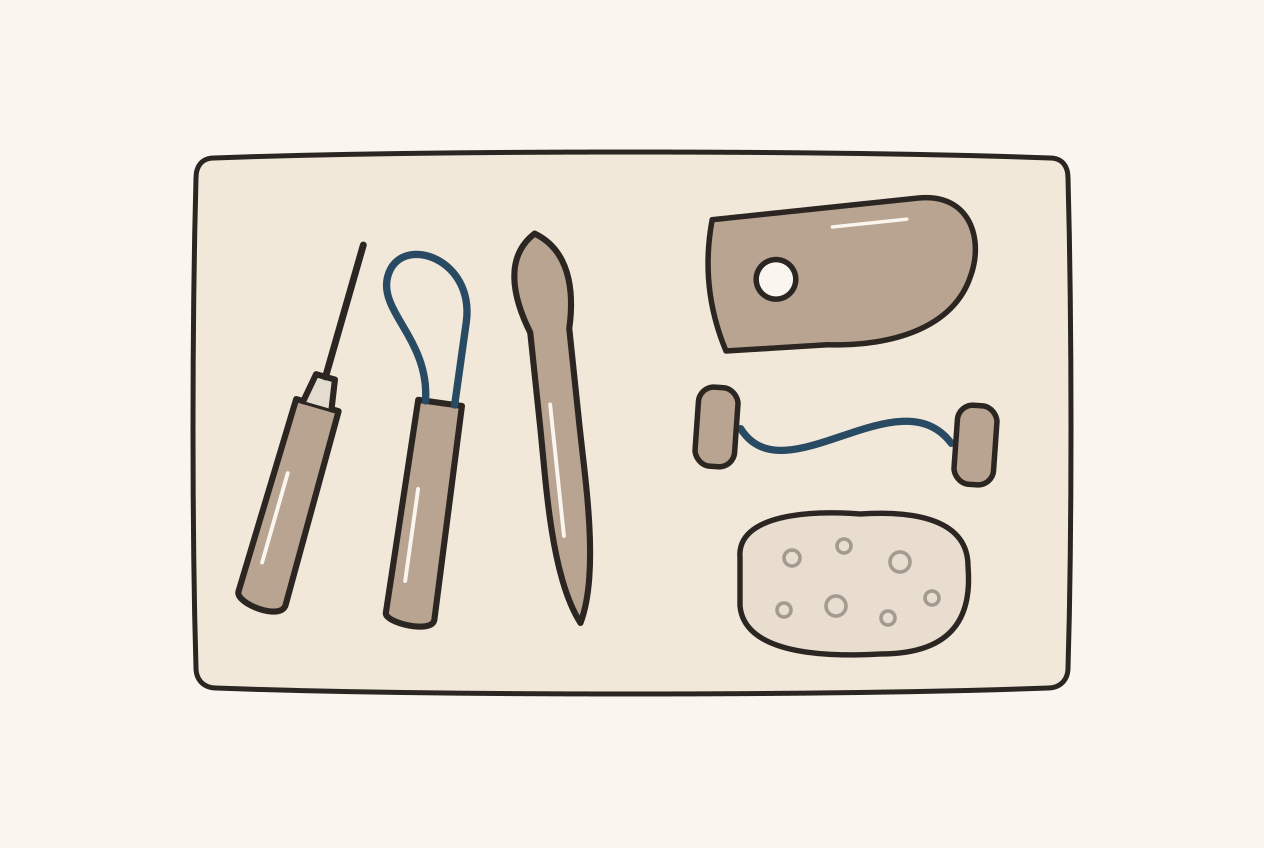
Most beginner pottery kits contain the same handful of tools. Once you know what each one does, a boxed set is much easier to judge. We use one of those sets at home, so this page starts with the tools themselves, then what we bought, and ends with what to ask your studio before you spend anything.
Short answer
What pottery tools does a beginner need?
A basic kit covers it: a needle tool, a wire clay cutter, a rib, a loop tool, a ribbon tool, a sponge, a wooden modeling tool, and a metal scraper. That is the exact contents list Kemper gives for its PTK Pottery Tool Kit, which it describes as made for the beginning potter. The PTK is the kit we use at home. Ask your studio what it already supplies before buying, and leave the wheel and kiln for later. This page has no test scores and no prices.
The core tools and what each one is for
These descriptions come from the manufacturer’s product pages for each tool in the Kemper kit, plus a university ceramics course text and a tool maker’s trimming guide. They are research, not our own test.

- Needle tool. A sharp steel point in a handle. A ceramics course text calls it one of the most versatile tools in ceramics, used for scoring, trimming, and measuring. Kemper lists cutting clay strips, designs, and holes.
- Wire clay cutter. A length of wire between two wooden toggles. Kemper describes it for slicing and cutting lump clay, and for trimming pots on the wheel.
- Rib. A flat, shaped tool for smoothing and shaping. The rib in the Kemper kit is hardwood, made for opening, shaping, curving, smoothing, and trimming wet clay on the wheel. Ribs also come in rubber, which compresses the surface on the wheel to help prevent cracks, and in metal, which is stiffer and suits trimming excess clay. Wooden ribs also suit shaping handbuilt pieces.
- Loop tool. A sharpened steel loop on a handle. Kemper describes it as removing controlled amounts of clay from wheel-thrown and sculpted pieces. Trimming starts once a pot is leather-hard, firm enough that a fingernail can press in without changing the shape.
- Ribbon tool. Sharpened stainless steel cutting ends on a hardwood handle. Kemper lists medium-duty cutting, shaping, and slicing, so it overlaps with the loop tool for removing clay.
- Sponge. For smoothing and cleaning seams, according to Kemper.
- Wooden modeling tool. A double-ended hardwood tool for cutting, slicing, smoothing, contouring, and pattern decorating in soft clay. Kemper describes it as covering a wide variety of shapes for basic clay modeling.
- Metal scraper. A thin, flexible piece of spring steel. Kemper lists shaping, smoothing, and trimming.
What we bought for home
The studio supplies the equipment during class. For practice at home, we bought a Kemper PTK Pottery Tool Kit. Kemper describes it as a beginner kit, and it has been a good one for us. For the price, it has been hard to beat.
The clear vinyl bag keeps the tools together, but we also stitched a small holder so the set stays organized. Wash and dry everything before putting it away. We learned that the hard way: a wooden rib from the beginner set does not like being left in water or put away dirty. When that rib was ruined, we switched to a Mudtools polymer rib. It feels good in the hand, cleans up easily, and so far seems likely to last.
We bought one refill of pottery sponges, but there was no need. The sponge guide shows how to cut them from a hardware-store car sponge. Mudtools sponges do feel higher quality, and the rounded shape sits more comfortably in the hand. A homemade sponge is the inexpensive version, not an identical one.
With notes on why each one stayed, here is everything we’ve bought so far.
Ask your studio first
We are interested in different sides of ceramics, handbuilding for her and the wheel for me, so our tool lists may grow in different directions. Our story covers how we each got into ceramics. That still does not call for two huge kits. Our handbuilding vs wheel comparison sets the two methods side by side. Start by asking what the class already provides. The table below is a way to sort possible purchases, not a ranking of brands. We have not tested those items for this guide, and the table has no product links.
| Question | Ask the studio first | Reasonable to own early | Can wait |
|---|---|---|---|
| Clay | Usually supplied, and outside clay may be forbidden. | Only if the studio tells you to bring a named body. | Do not stock 50 lb because a product page has a minimum. |
| Basic hand tools | Many classes set out needles, ribs, sponges, and wires. | A personal tool is fine once you know the kit is short. | Sets sold as complete studios. |
| Measuring | A shared ruler may exist. | A small ruler or caliper you will actually put in the log. | Gauges you do not yet know how to read. |
| Clothes and towel | The studio’s dress rule. | Clothes you can wash separately, as Princeton’s ceramics page recommends for clay work. | Anything you need to keep clean. |
| Notebook | Not a studio-supplied item everywhere. | The process log, paper or the printable file. | A second app that duplicates the same fields. |
| Wheel | Class wheels are the usual first throwing setup. | Not a first-week purchase. | A home wheel before you know you will keep throwing. |
| Kiln | The studio fires, or it does not. Ask. | Not from this page. | A home kiln until a manufacturer checklist and a qualified installer are in play. |
Who should wait before buying
- Someone who has not asked the studio what is included. Start with the class questions.
- Someone shopping for a kiln from a general “beginner tools” article. Skutt’s manual index is organized by controller, and the manual has to match the kiln. That is a document for the owner and a qualified installer. We don’t cover kiln buying, so start with the kiln’s manufacturer.
- Someone who wants a scored ranking. There is no hands-on test behind this page, so there is no score.
If a seller’s page is useful later, it should be the manufacturer’s current page for a specific model, checked on the day you read it, with the price left on that page rather than copied here.
What we are taking from this
A small kit of basic hand tools is enough to start. Let the class and the work you want to make guide anything you add after that—not the size of a boxed set. For a first project, the printable dog template needs little more than a needle tool, a fork for scoring, and a sponge.
Sources (13)
: Kemper Tools, Jessica Fong, University of the Pacific, on Humanities LibreTexts, DiamondCore Tools and more
- PTK - Pottery Tool Kit — Kemper Tools. Product description and kit contents. Supports: Kemper describes the PTK as perfect for the beginning potter, in or out of the classroom, used by schools and universities, packed in a reusable clear vinyl bag with pockets. Kit contains one each: loop tool (LT5), ribbon tool (8R2), potter's rib (RB2), needle tool (PRO), wood modeling tool (WT6), sponge (SPR), scraper (S4) and wire clay cutter (K35).
- PRO Needle Tool — Kemper Tools. Product description. Supports: Used to cut heavy clay strips, designs, and holes; a sharp steel needle in a textured aluminum handle for a firm grip with wet hands.
- K35 Wire Clay Cutter — Kemper Tools. Product description. Supports: Ideal for slicing and cutting lump clay, as well as trimming pots and other projects on the wheel. Hardwood toggle handles on roughly 18 inches of stainless steel wire.
- RB2 Potter's Rib — Kemper Tools. Product description. Supports: A smooth-finished hardwood rib in the basic shapes for opening, shaping, curving, smoothing and trimming wet clay on the potter's wheel.
- LT5 Loop Tool — Kemper Tools. Product description. Supports: Used to remove controlled amounts of clay from wheel-thrown and sculpture pieces; the cutting head is sharpened stainless steel ribbon.
- 8R2 Ribbon Tool — Kemper Tools. Product description. Supports: Used by potters and sculptors for medium duty clay cutting, shaping, and slicing; sharpened stainless steel ends on hardwood handles.
- SPR Sponge — Kemper Tools. Product description. Supports: A sponge for smoothing and cleaning seams, about 2.75 inches in diameter.
- WT6 Wood Tool — Kemper Tools. Product description. Supports: Used for cutting, slicing, smoothing, contouring, and pattern decorating in soft clay; a variety of shapes for basic clay modeling.
- S4 Steel Scraper — Kemper Tools. Product description. Supports: Used for shaping, smoothing and trimming pottery shapes; made from thin, flexible spring stainless steel.
- 2.2: Essential Tools and Their Uses — Jessica Fong, University of the Pacific, on Humanities LibreTexts. Basic Tools: needle tool and rib tool. Supports: The needle tool is one of the most versatile tools in ceramics, used for scoring, trimming, and measuring. Rubber ribs compress the clay surface on the wheel to prevent cracks; wooden ribs are lightweight and suit shaping hand-built pieces; metal ribs are more rigid, for trimming excess clay during throwing.
- Pottery Trimming Techniques — DiamondCore Tools. When to trim. Supports: You should begin trimming your clay when it is leather-hard, firm enough to press a fingernail in without disturbing the shape.
- Ceramics — Princeton University Office of Environmental Health and Safety. Clay hazards and precautions, and the lead-leaching section. Supports: Separate work clothes that do not trap dust, wet cleanup of clay scraps, and avoiding dry sanding of greenware are occupational precautions. A lead-safe label is not the same as a lead-free material, and craft studios do not automatically match industrial leaching tests.
- Kiln manuals — Skutt Ceramic Products. Manual index introduction. Supports: Skutt says its kiln manuals are listed by the controller they use, and that the reader should open the manual for their kiln. The index is not a substitute for the matching model and controller revision.