Clay & Forming · How-to
What Is Clay Shrinkage? How to Calculate It
5 min read
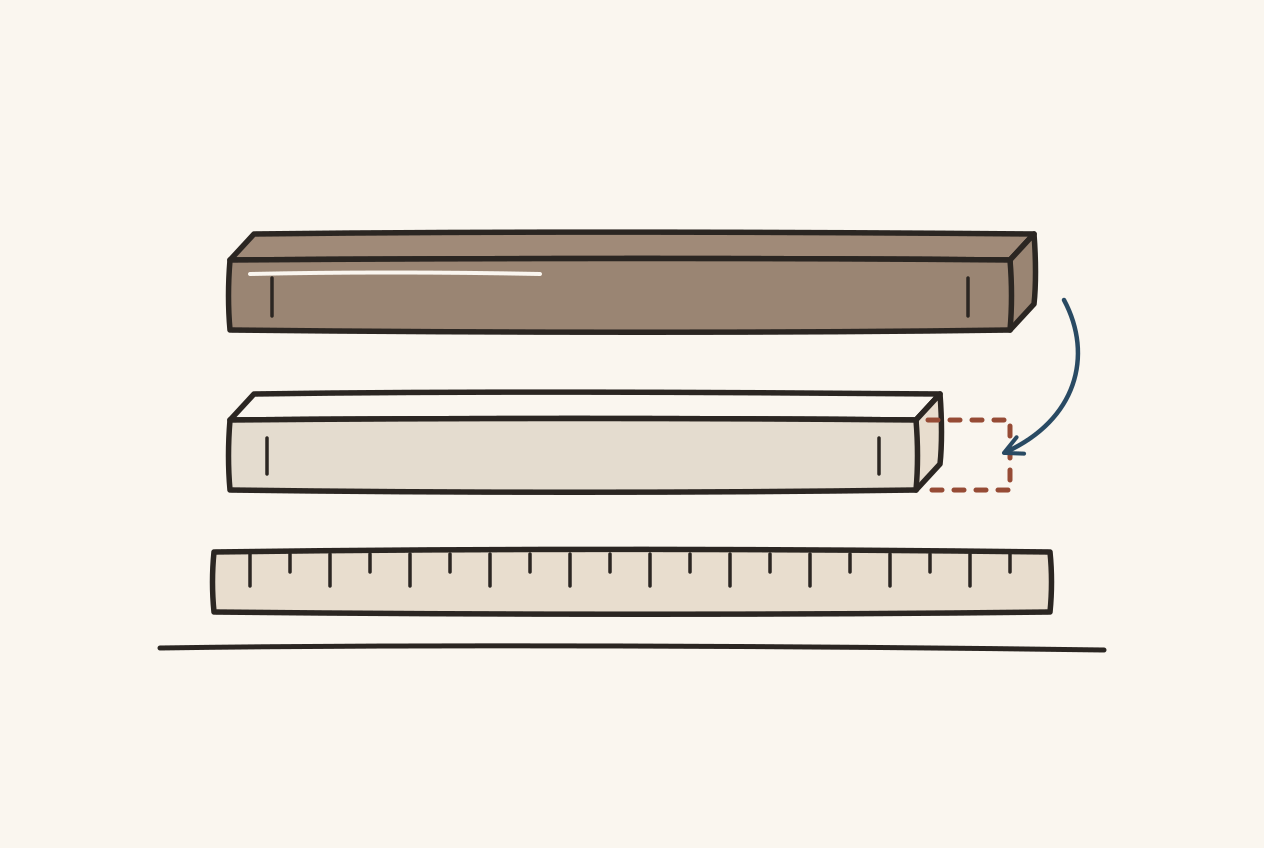
Wanting to make pieces that belong together brings up a practical question: how big should something start if it will get smaller? We are looking into the arithmetic behind that question as part of learning about clay.
The examples here use made-up measurements to explain the maths. They are not results from our own pots, and they cannot predict an untested clay.
Short answer
What is clay shrinkage, and how do I calculate it?
Clay shrinkage is how much a piece gets smaller in two stages: during drying, as the water between the clay particles evaporates and the particles pack closer together, and again during firing, as the dry clay itself densifies in the kiln. Tony Hansen’s Digitalfire glossary puts the drying shrinkage of a typical plastic pottery clay at about 6 percent, with workable plastic bodies running from about 5 to 7.5 percent, and his worked example comes to 12.5 percent in total once firing is included. The number changes from one clay body to the next: the makers’ figures in the table below run from 6.3 to 13 percent.
Linear shrinkage percent is 100 times (initial length minus final length) divided by the initial length. To start large enough for a desired finish, divide the desired length by (1 minus the shrinkage percent divided by 100). Name the stage. Do not add two stage percentages, and do not use a water-absorption number.
Clay shortens as water leaves it in drying, and again as it densifies in firing. Tony Hansen’s drying notes make the practical point: shrinkage that happens unevenly is what over-stresses a piece. The percentage you calculate is only as useful as the two lengths and the stage you write beside them. This page is the arithmetic. It is not a prediction for a clay you have not measured, and it is not a kiln program.
The diagram at the top is an illustration of the two lengths. It is not a photograph of a test bar from a named body.
Shrinkage by clay type: what makers list
Clay makers print a shrinkage figure on each clay’s product page. These are the figures for five of the clays in our earthenware, stoneware and porcelain buying guides, as each maker listed them. Each row is one clay, not an average for its family.
| Clay type | Clay | Maker’s cone | Listed shrinkage |
|---|---|---|---|
| Earthenware (low-fire) | AMACO White Art No. 25 | Cone 04 to cone 3; figure given at cone 04 | 6.3% |
| Stoneware (mid-fire) | Laguna Redstone WC420 | 5 or 6 | 10.5% |
| Stoneware (mid-fire) | Laguna B Mix with Speckles WC408 | 5 (do not fire past 5) | 12.47% |
| Porcelain (mid-fire) | Laguna Frost WC437 | 6 | 11% |
| Porcelain (high-fire) | Laguna Dave’s Porcelain WC384 | 10 | 13% |
AMACO lists White Art No. 25 at 6.3 percent shrinkage at cone 04. Laguna lists Redstone at 10.5 percent for cone 5 or 6, B Mix with Speckles at 12.47 percent at cone 5, Frost at 11 percent at cone 6, and Dave’s Porcelain at 13 percent at cone 10. The figures come from the makers’ pages as recorded on 23 October 2026. None of those pages said which stages the figure covers, so we do not call it total shrinkage, and it is not comparable with Hansen’s 6 percent, which is drying alone.
Every clay differs, even within one family: the two Laguna porcelains here are 2 points apart. The one earthenware in the table is lower than the others, but that is one clay, not a rule for earthenware. Use a maker’s figure to compare clays or to choose one. To plan a size, measure a test bar of the clay you actually have with the formulas below. The guides for earthenware, stoneware and porcelain list the rest of each clay’s figures.
The two formulas

Measured shrinkage:
100 × (initial − final) / initial
Starting length:
desired final / (1 − shrinkage percent / 100)
If you have a wet-to-dry percentage and a separate dry-to-fired percentage, the combined linear shrinkage is:
1 − (1 − first fraction) × (1 − second fraction)
Five percent followed by 7 percent is 11.65 percent, not 12 percent. Adding the percentages double-counts the length that already shrank in the first stage.
Our free vessel calculator applies the starting-length formula for you, and the dog and cat templates use it to print pieces at the right size. The clay dog project walks through building from the dog template. If you want to price a finished piece, the pricing calculator adds up clay, glaze, firing, time, and overhead.
Mark a length on wet clay
A straight test bar or a scratch on the piece is enough if you can find both ends later. Record the number and the unit in the log.
Measure the same marks at the second stage
Wet to dry, dry to fired, or wet to fired. Do not mix a dry measurement into a wet-to-fired percentage.
Divide using the first formula
100 mm down to 88 mm is 12 percent. Ten inches down to nine inches is 10 percent. The same lengths in centimetres, 25.4 cm to 22.86 cm, are also 10 percent.
Plan a finish with the second formula
For 100 mm after 12 percent shrinkage, start at 100 / 0.88, which is 113.636… mm. For 10 cm after 12 percent, start near 11.36 cm (11.3636… cm). Multiplying 10 by 1.12 to get 11.2 cm is the wrong shortcut.
Keep 0 percent and impossible numbers honest
At 0 percent shrinkage the starting length equals the desired finish. An initial length of zero, a negative length, a blank, or a shrinkage of 100 percent or more should be rejected, not quietly repaired. If the final length is longer than the initial length, you are looking at expansion or a swapped measurement, not a negative shrinkage target.
Which numbers belong in the calculation?
A product sheet can list shrinkage and absorption side by side. On Laguna’s WC429 page, those were 12 percent and 0.5 percent, and the page did not name the shrinkage stage. The 0.5 percent figure is not the input for this formula. The sheet-reading guide shows the other fields that also do not belong in this calculation.
Linear percentage is not volume percentage. Do not cube it, and do not use it as a clay-ordering formula.
Download the measurement log Write the stage next to both lengths.
Work the 100 mm and 88 mm example on paper using these formulas, and record the stage alongside the result.
Limits
The same clay can shrink differently when the thickness, the drying setup, or the firing changes. Hansen’s point about uneven drying is why a single percentage does not diagnose a crack. If a piece cracks, use the drying checks before you decide the clay body is the cause.
What we are taking from this
Keep the lengths, units, and stage together. A neat percentage is only useful when we know what it describes.
Sources (8)
: Digitalfire, Tony Hansen, Laguna Clay & Glaze Co, AMACO (American Art Clay Co.)
- Drying Ceramics Without Cracks — Digitalfire, Tony Hansen. Ware shrinks when it dries; Isolate the stage where drying gradients are introduced; Give consideration to each type of piece; Clay is composed of microscopic flat crystals; Conclusion; and the picture notes on mugs, handles and foot rings. Supports: Hansen says it is the unevenness of drying, not its speed, that makes ware crack, and that at no time should any part of a piece be significantly ahead of another. A moisture spread introduced early (for example by an unshielded draft, or ware left out too long after forming) tends to remain, and in one of his examples covering mugs with cloth and plastic after the rims had stiffened did not save them. He recommends covering ware with cloth and plastic, waxing or wrapping handles so they keep pace with the body, slowing fast-drying sections with wax resist or latex at leather-hard, turning bowls over as soon as possible, even wall thickness with bases trimmed to the same thickness as the walls, avoiding sharp concave angles, and compressing the bottoms of wide thrown pieces to reduce drying stress (while saying even thickness and even drying, not compression, are the key). His conclusion: take cracked ware seriously, because a few cracked pieces can reveal a flawed process. The article gives no method for repairing a crack that has already opened. This is a technician's published explanation, not a test run for this site.
- WC429 RSMC Special ^5-6 moist clay, boxed — Laguna Clay & Glaze Co. Product specification block. Supports: On that date the page described WC429 as a cone 5 to 6 red stoneware, listed shrinkage 12%, water absorption 0.5%, COE 4.6, and a penetrometer value, and included tableware among applications. It did not define which shrinkage stages the 12% covers.
- Drying Shrinkage — Digitalfire, Tony Hansen. Opening glossary definition and the total-shrinkage example. Supports: Hansen says clays used in ceramics shrink when they dry because of particle packing as inter-particle water evaporates, and that excessive or uneven shrinkage causes cracks. He says a typical plastic pottery clay shrinks about 6% in drying, that highly plastic bodies can shrink up to about 7.5% before drying cracks become difficult to avoid, and that shrinkage can be reduced to 5% or below before plastic bodies become too difficult to form. He notes dry and fired shrinkage cannot simply be added: in his example 6.25 dry plus 6.66 fired would be 12.9, whereas the actual total shrinkage is 12.5%. This is a technician's published explanation, not a measurement for any one clay and not a test run for this site.
- White Art Clay No. 25 — AMACO (American Art Clay Co.). Product description. Supports: AMACO describes White Art Clay as an extremely plastic low-fire clay for wheelthrowing, handbuilding, and modeling. It fires off-white, has a firing range from cone 04 to cone 3, recommends AMACO glazes maturing at cone 05, and lists shrinkage of 6.3% and absorption of 13.7% at cone 04. Sizes offered are 25 lb and 50 lb.
- WC408 B-Mix ^5 with speckles moist clay, boxed — Laguna Clay & Glaze Co. Product description, firing warning, and specification block. Supports: Laguna says WC408 has the same working properties as B-Mix WC401 and describes it as a mid-temperature, smooth, porcelaneous stoneware that prefers slow drying and compression on rims and bottoms. The page warns not to fire past cone 5 and lists cone 5, 12.47% shrinkage, 2.47% water absorption, and COE 7.07. It does not describe what the speckles look like after firing.
- WC420 Redstone ^5 moist clay, boxed — Laguna Clay & Glaze Co. Product description and specification block. Supports: Laguna describes Redstone as a red stoneware with medium grog and minimal porosity at cone 6, for handbuilding and throwing small to medium pieces, firing warm brick red in oxidation. It lists cone 5 or 6, red wet color, 10.5% shrinkage, 0.5% water absorption, COE 5.52, and applications that include sculpture, throwing, handbuilding, and tableware.
- WC437 Frost porcelain moist clay, boxed — Laguna Clay & Glaze Co. Product description and specification block. Supports: Laguna describes Frost as an exceptionally white and translucent throwing porcelain for cone 5-6. The specification block lists cone 6, white wet color, 11% shrinkage, 0.5% water absorption, and COE 7.14, with applications that include throwing and handbuilding small to medium pieces and tableware.
- WC384 Dave's Porcelain ^10 moist clay, boxed — Laguna Clay & Glaze Co. Product description and specification block. Supports: Laguna describes Dave's Porcelain as a throwing body for thin walls and larger pieces, and for slab use when a vitreous clay is wanted. It fires light gray in reduction and off-white in oxidation. The page lists cone 10, white wet color, 13% shrinkage, 0.5% water absorption, and COE 5.83.