Clay & Forming · Comparison
Types of Pottery Clay: Earthenware, Stoneware, Porcelain
4 min read
Short answer
What are the main types of clay for pottery?
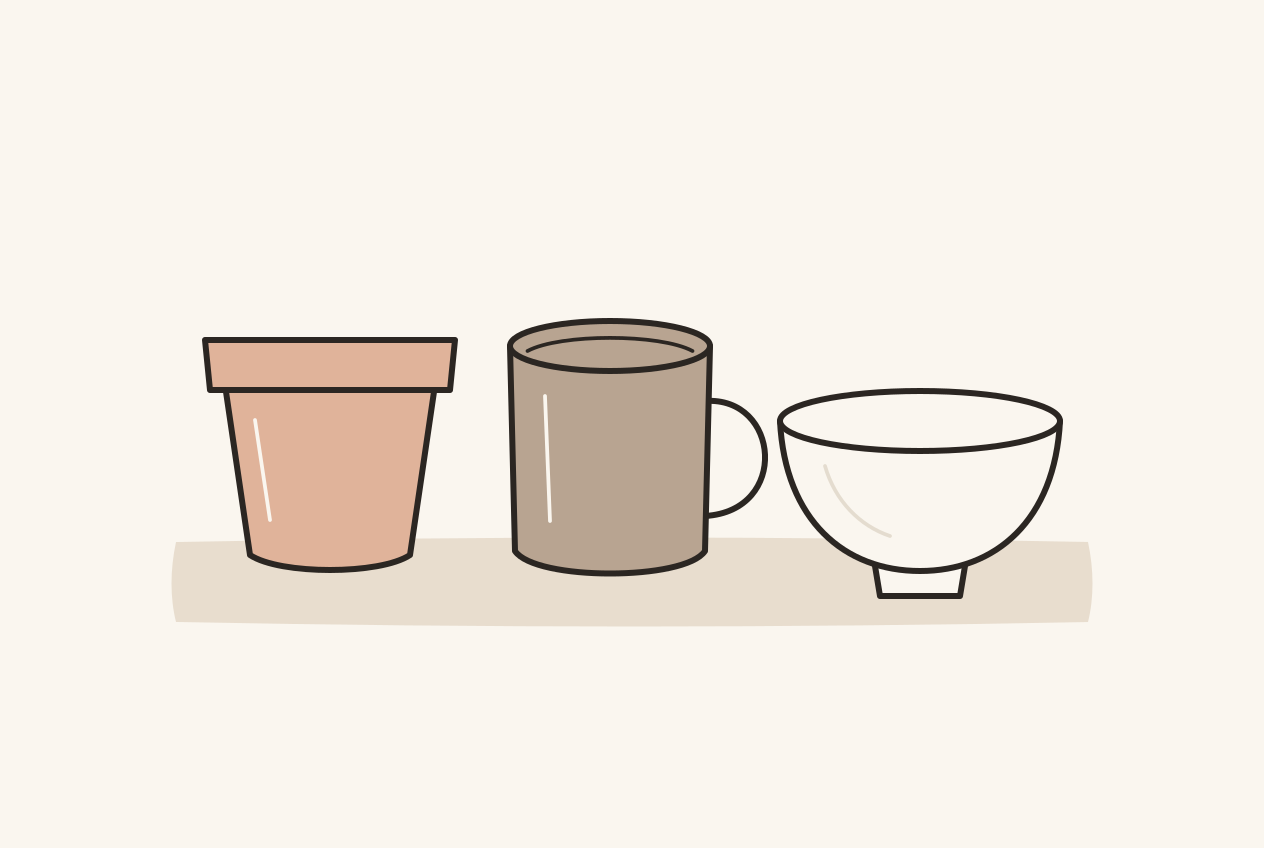
The three main types of kiln-fired pottery clay are earthenware, stoneware, and porcelain. Earthenware is fired at lower temperatures and usually stays porous. Stoneware is fired hotter, until it is dense enough for durable ware. Porcelain is a white, glassy (vitreous) body that can be translucent when it is clean and well fired. The families overlap at the edges, so the sheet for the clay you buy has the final word on its firing range.
If you are learning to make pottery, these are the three types of clay you will hear about first, on class sign-up pages, on clay bags, and in every glaze chart. We wanted a clearer way to understand what each name describes. This is our reading guide to the differences, not a ranking of which clay is best. Air-dry clay is a separate material that is never fired, and it has its own guide.
We are sharing the explanations in the sources below, rather than claiming we have worked with and tested all three.
Tony Hansen’s Digitalfire glossary gives a technician’s account of each family. He describes earthenware as low-temperature ware, often in the cone 010 to cone 04 region, lacking the glass that fills pores in stoneware, and he notes that some terra-cotta bodies can densify if fired hotter. He describes stoneware as high-temperature, typically non-white bodies fired dense enough to be durable, and he argues against identifying them by one chemistry formula. He describes traditional porcelain as comparatively white and vitreous, normally from feldspar, clay, and quartz, and possibly translucent when it is clean and well vitrified. He also discusses porcelain approaches at more than one temperature. His cone ranges describe the families; the sheet for your own clay sets its firing.
The differences, side by side

| Question | Earthenware | Stoneware | Porcelain |
|---|---|---|---|
| How Hansen frames it | Lower-temperature bodies that usually stay more porous because they develop less glass. | Higher-temperature bodies fired dense enough for durable ware, across more than one chemistry. | White-burning, vitreous bodies that can be translucent when clean and sufficiently fired. |
| A cone context he uses | Often around cone 010 to cone 04. Some terra-cotta bodies can densify if fired hotter. | Mid to high fire, often cone 6 in his notes. | Often associated with high fire, with variants he says can mature lower. |
| What a commercial sheet still has to say | The exact body’s range, shrinkage stage, and absorption. | Same. Laguna WC429 is sold as cone 5 to 6 stoneware with its own figures. | Same. |
| Food, microwave, dishwasher, oven | Not established by the family name. | Not established by the family name. | Not established by the family name. |
Where to buy each type
Buy the clay that matches the kiln you will fire in, and if a studio fires your work, ask which clays it accepts first. Our guide to choosing pottery clay for beginners walks through that decision by kiln. Our buying notes for each type:
- Earthenware clay for beginners, for low-fire kilns
- Stoneware clay for beginners, for cone 5 or cone 6 kilns
- Porcelain clay for beginners, for when you want a white, glassy body
At home we use SIO-2 PRAI, a white clay sold as cone 6 to 10 stoneware, and fire it at about 1250°C (2282°F). It is on our list of everything we have bought so far.
What the names leave out: food use
A lead-free label does not settle the food question. The U.S. FDA’s 2010 guidance describes imported pottery labeled “lead free” that still showed extractable lead. That is U.S. guidance, and it is no home test. We don’t cover food safety on this site; before you sell or give a pot for food use, ask your studio or the clay and glaze maker.
Laguna’s WC429 page uses the word tableware in an application list. The sheet guide treats that word as the manufacturer’s claim rather than a leaching result.
What to look for on the bag
- Write the clay’s full product name into the log, along with its family.
- Copy the cone with any leading zero.
- If you need a finished size, measure shrinkage for a named stage, using your own clay’s numbers rather than another family’s percentage.
- If the question is whether the fired piece may touch food, stop. The family table is the wrong tool.
The shrinkage guide is the arithmetic once you have two lengths of the clay you actually have. If you are planning a mug or bowl, our vessel calculator works out the throwing size and how much clay to weigh out.
What we are taking from this
The family names are helpful vocabulary, but the exact clay and its documented requirements still matter.
Sources (7)
: Digitalfire, Tony Hansen, The Edward Orton Jr. Ceramic Foundation, U.S. Food and Drug Administration and more
- Earthenware — Digitalfire, Tony Hansen. Glossary definition. Supports: Hansen describes earthenware as low-temperature ware, often discussed around cone 010 to cone 04, that lacks the glass development of stoneware and is typically porous. He also notes some terra-cotta bodies can densify if fired hotter, so the family name is not a maturity guarantee.
- Stoneware — Digitalfire, Tony Hansen. Glossary definition. Supports: Hansen describes stoneware, for potters, as high-temperature non-white bodies fired dense enough for durable ware, and he warns against identifying it by a single chemistry formula. He discusses bodies across a range that includes cone 6, so stoneware is not one cone number.
- Porcelain — Digitalfire, Tony Hansen. Opening definition and the plasticity and warping paragraphs. Supports: Hansen describes traditional utilitarian porcelains as comparatively white-burning vitreous bodies normally made from feldspar, clay, and quartz, which can be translucent when impurities are low and vitrification is sufficient. He writes that plastic porcelains have traditionally been much shorter (less plastic) than stoneware or earthenware, and that porcelains tend to warp during firing because they are taken closer to the melting point. He also discusses lower-temperature variants, so porcelain is not one temperature.
- Pyrometric Cones FAQ — The Edward Orton Jr. Ceramic Foundation. Why cones are numbered from 022 to 42, and the cone 06 example. Supports: The zero series uses a leading zero instead of a minus sign. Cone 022 is the lowest of that series and cone 01 is the hottest of it. Orton’s FAQ gives self-supporting cone 06 and large cone 06 fast-fire chart readings as different from each other and from cone 6.
- Guidance for Industry: Safety of Imported Traditional Pottery and the Use of the Term Lead Free — U.S. Food and Drug Administration. November 2010 guidance, sections on lead-free labeling and decorative ware. Supports: FDA describes U.S. cases where pottery labeled lead free still had extractable lead. The guidance is U.S. thinking, not a worldwide compliance certificate, and a label alone is not the leaching test.
- WC429 RSMC Special ^5-6 moist clay, boxed — Laguna Clay & Glaze Co. Product specification block. Supports: On that date the page described WC429 as a cone 5 to 6 red stoneware, listed shrinkage 12%, water absorption 0.5%, COE 4.6, and a penetrometer value, and included tableware among applications. It did not define which shrinkage stages the 12% covers.
- Cone 6 — Digitalfire, Tony Hansen. Opening glossary definition. Supports: Hansen says potters also call cone 6 (about 2200F/1200C) "middle temperature", that it is the range at which most hobby and pottery stonewares and porcelains are fired, and that it is the medium-temperature oxidation range most potters work in using electric kilns. He gives no survey figure, so this is a technician's characterization, not a count of studios.